The Brains Without Hands Problem: Why Foundation Labs Will Reshape Biology
The convergence of AI and biology is no longer speculative. Foundation labs are making moves, capital is flowing, and the competitive landscape is forming. This is an attempt to map what's happening, why it's happening now, and where the value will likely land.
The Brains Without Hands Problem: Why Foundation Labs Will Reshape Biology
The convergence of AI and biology is no longer speculative. Foundation labs are making moves, capital is flowing, and the competitive landscape is forming. This is an attempt to map what's happening, why it's happening now, and where the value will likely land.
Written by Alexey Morgunov, Venture Partner at BACKED, who leads the thinking on the intersection of AI and biotech at the fund.
The most consequential moves in technology often look inevitable in retrospect. We're approaching one of those moments now. The same companies that built the infrastructure for artificial general intelligence (OpenAI, Anthropic, Google DeepMind) are on a collision course with biology. Not as a speculative pivot, but as theological next step in deploying intelligence where it creates the most value.
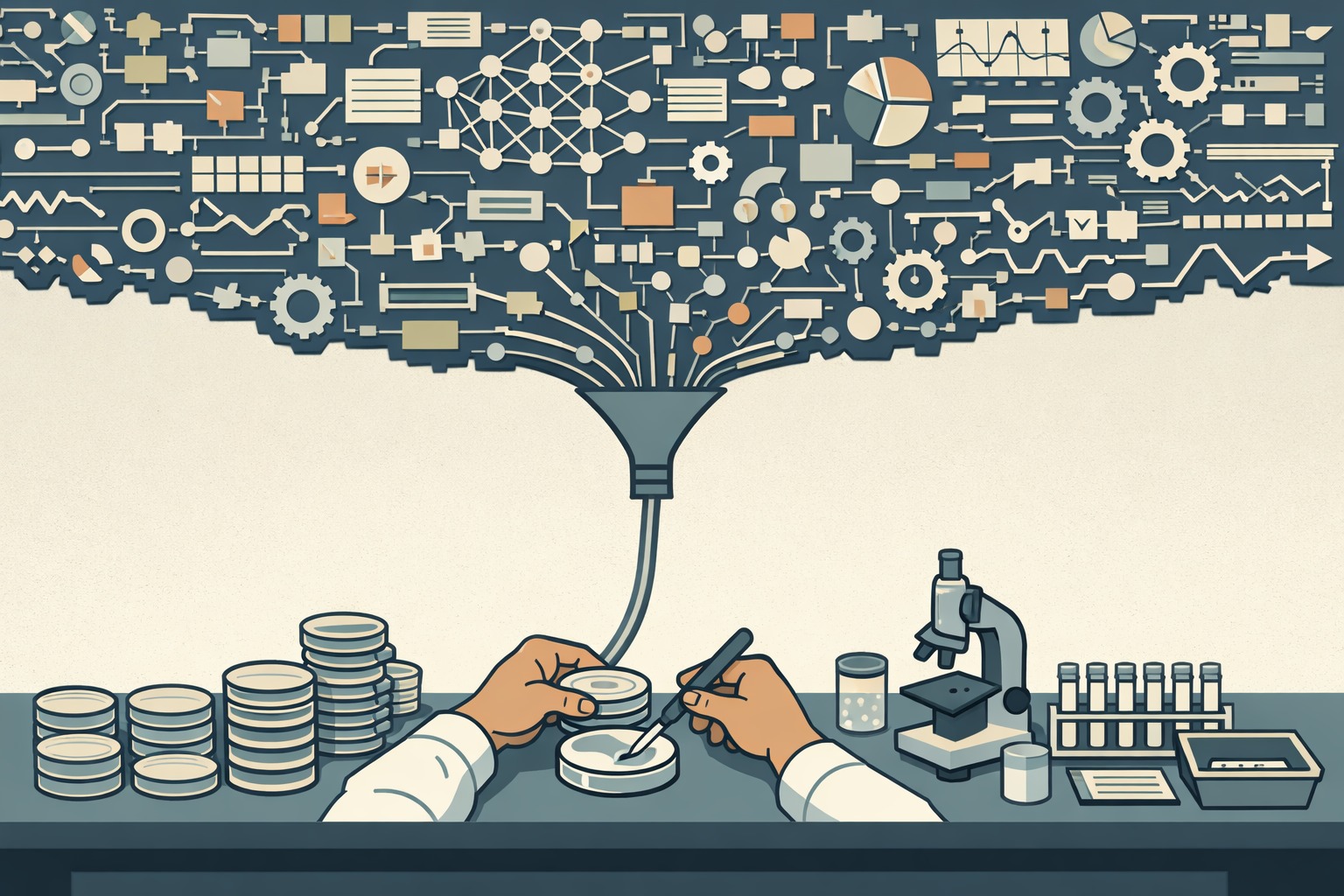
The thesis is straightforward: foundation labs will progressively verticalize into biology, and the central bottleneck they'll encounter is not cognitive capability but physical execution. The companies that solve this"brains without hands" problem will capture disproportionate value in the coming decade.
This is already happening. OpenAI's GPT-4b micro achieved an alleged 50-fold improvement in stem cell reprogramming marker expression. Anthropic launched Claude for Life Sciences, featuring customers like NovoNordisk and Sanofi. Isomorphic Labs is preparing AI-designed oncology drugs for human trials, with partnerships that could be worth nearly $3 billion in milestones. Every major foundation lab has made significant moves into biology within the past eighteen months.
We've seen AI-pharma hype cycles before1. What's different now is that models are producing physical artefacts that clear wet-lab gates: not just predictions, but novel proteins that outperform natural variants. Investment is flowing into laboratory automation and robotics, not just AI compute. And the closed-loop paradigm, treating experiments as training signal for the next generation of models, creates compounding returns that previous approaches lacked.

The Logic of Entry
Intelligence alone doesn't create value. Value emerges when intelligence meets problems where outcomes matter economically and scientifically. And few domains present as large a gap between available intelligence and unrealized value as biology, or as much existing digitized data to work with.
The numbers tell the story: drug discovery costs exceed $2 billion per approved compound with a 90% failure rate. GLP-1 agonists demonstrate what happens when medicine crosses from treatment into lifestyle: Novo Nordisk and Eli Lilly are now among the most valuable companies on earth, built on drugs that blur the line between pharmaceutical and consumer product. Longevity, personalized medicine, preventive health: these markets could follow the same trajectory.
If AI-driven discovery can systematically find more such crossover molecules (targeting aging, cognition, metabolism, and performance), the addressable market expands beyond traditional pharma. And regardless of market size, value migrates to prediction: better odds on which molecules to develop is the entire game.
The question is who captures that value. Foundation labs are uniquely positioned to attack these problems. They've developed a specific set of capabilities through the AI scaling era: comfort with massive capital expenditure on uncertain long-horizon bets, expertise in extracting signal from messy heterogeneous data(biological data being arguably the messiest domain in existence), and willingness to deploy AI in contexts where traditional approaches seem more conservative.
The logic is simple. Once the low-hanging fruit in software is exhausted, once coding assistants and customer service agents and content generation are mature, biology becomes the obvious next frontier. It's the domain where intelligence can be most profitably deployed, and foundation labs are the entities best equipped to deploy it.
The strategies differ in telling ways, and the variation is instructive. OpenAI and DeepMind are pursuing drug discovery directly. OpenAI partnered with Retro Biosciences to build GPT-4b micro for protein engineering, while DeepMind spun out Isomorphic Labs with major pharma partnerships and candidates approaching clinical trials. These are bets on owning the molecular design layer.
Anthropic is making a different bet: that the binding constraint is orchestration and execution infrastructure, not models alone. By positioning Claude as the connective layer between scientists and their tools (Benchling for notebooks, PubMed for literature, 10x Genomics for single-cell data), Anthropic is building toward a "lab operating system" that sits at the chokepoint between AI capability and laboratory execution.
This is a strategic land grab. Benchling already has 200,000+ scientists on its R&D cloud platform at companies like AstraZeneca, Regeneron, and Gilead, representing a $6.1 billion valuation built on being the system of record for laboratory work. By integrating Claude directly into this existing infrastructure, Anthropic doesn't need to replace what's there; it needs to become indispensable to it. As Anthropic's head of life sciences put it: "We want a meaningful percentage of all of the life science work in the world to run on Claude."
The divergent strategies point to a broader truth: winning in AI-driven biology doesn't require owning wet labs. There are three viable paths. You can own the loop by building internal autonomous labs. You can orchestrate the loop by controlling integrations, agents, and data layers across third-party infrastructure. Or you can rent the loop by forming tight partnerships with specialized experimental platforms. Different players will capture value at different layers: drug IP, workflow lock-in, data gravity, or compute consumption. Physical execution remains the bottleneck; the approaches to controlling it vary.
The Asymmetry: Bits Accelerating, Atoms Lagging
On the computational side, the pieces are falling into place faster than most observers expected. We have protein structure prediction that rivals experimental methods. Molecular property prediction that can screen billions of compounds in silico. Literature synthesis that processes the entire biomedical corpus. Agentic systems capable of formulating hypotheses and reasoning about biological mechanisms.
The results are no longer theoretical. OpenAI's GPT-4b micro created novel proteins called RetroSOX and RetroKLF that differed by more than 100 amino acids from wild-type sequences while maintaining superior function. Over 30% of AI-designed variants outperformed the natural protein, versus less than 10% with traditional methods. EvolutionaryScale's ESM3 generated esmGFP, a novel fluorescent protein representing an estimated 500 million years of natural evolution, with only 58% identity to any known fluorescent protein. These aren't incremental improvements; they're demonstrations that AI can navigate protein space in ways humans cannot.
Even the intellectual labor of scientific reasoning is being automated. Future House's Kosmos system claims to accomplish work equivalent to six months of PhD research in a single run, reading roughly 1,500 papers and executing 42,000 lines of analysis code for $200. The "brains" are increasingly commodity.
The trajectory points in one direction: AI systems are becoming increasingly competitive with expert teams on well-specified discovery subtasks, from target identification to molecule optimization. The cognitive capacity is there or rapidly arriving. More than 30 AI-designed drugs are now in human trials, though definitions vary and broader counts run higher2.
To be clear: discovery throughput is not clinical success. Protein engineering wins are not drug approvals. The gap between generating promising candidates and proving they work in humans remains vast. Yet the acceleration on the computational side is real and continuing.
Biology, however, isn't a purely computational domain. Unlike software, where the product is bits and deployment is digital, biology requires physical intervention. Drugs must be synthesized. Cells must be cultured. Experiments must be run. Patients must be treated.
And on this physical side, the infrastructure is shockingly primitive.
Every laboratory operates differently. Protocols that work in one lab fail in another due to subtle differences in technique, equipment calibration, or environmental conditions. The "same" experiment run by two different technicians often produces different results: over 70% of researchers report being unable to reproduce others' experiments (per a 2016 Nature survey). Most laboratory work is still performed by human hands, which are slow, expensive, error-prone, and fundamentally unscalable. A graduate student runs dozens of experiments per week; an automated system could run thousands. But that automation doesn't exist at the required level of integration and reliability.
Laboratory automation does exist. Emerald Cloud Lab operates 150+ remotely controllable instruments. Strateos ran 23 robotic workcells before pivoting away from public cloud lab access. But the infrastructure remains fragmented, vendor-specific, and difficult to integrate. There is no "operating system" for the lab that allows AI agents to seamlessly orchestrate experiments across instruments, manage inventory, and capture standardised data. The pieces exist; the integration doesn't3.
Perhaps most critically, the knowledge that makes experiments actually work (the subtle adjustments, the timing intuitions, the "feel" for when a protocol is going well) lives entirely in the heads of experienced practitioners. It's transmitted through apprenticeship and almost never captured digitally. When a senior scientist retires, this knowledge often disappears. Some startups are attempting to solve this. Medra, for instance, captures what they call "infra-data": videos, metadata, timing, and actions for every sample, creating the rich experimental datasets needed for training scientific AI. This missing data is both the problem and the opportunity. If this knowledge can be captured systematically, it could become capability that agents invoke on demand.
This is the binding constraint. Not models, but execution. We have cognition on demand; what we lack is the ability to act on that cognition at scale in the physical domain. Solving it requires parallel efforts across multiple fronts.
The Workstreams
Foundation labs won't enter biology all at once. The capital requirements are too large, the domain knowledge too specialized, and the regulatory landscape too complex. But the buildout is happening across four parallel workstreams that reinforce each other.
Data organisation and training environments. This is well underway. Foundation labs are making sense of existing biological data: building unified ontologies, cleaning and harmonizing public datasets, constructing knowledge graphs. Arc Institute's Virtual Cell Atlas now contains 300+ million cells. CZI's Billion Cells Project is generating open-source data spanning mouse, zebrafish, and human cells. These are the "gyms" where AI agents learn to reason about cellular biology before connecting to physical labs. Arc's Virtual Cell Challenge, with over 5,000 registrations and a $100,000 prize, is establishing the evaluation standards that will benchmark progress, much as CASP did for protein folding.
The scope is expanding beyond genomics. Others are tackling adjacent problems. Cellular Intelligence, for instance, is attempting what they call "AlphaFold for developmental biology": a universal model of cell signaling that predicts how stem cells respond to time-varying chemical signals. Only a small fraction of known human cell types can be reliably produced for therapy today; the goal is to enable production of any cell type on demand. This is the kind of capability that unlocks entirely new therapeutic modalities.
Early R&D validation. This workstream connects AI systems to actual experiments, closing the training loop: experimental results improve models, which generate better hypotheses, which drive better experiments. This is active now at Retro Biosciences (OpenAI's GPT-4b collaboration) and through Isomorphic's pharma partnerships. The Recursion-Exscientia merger created a platform with tens of petabytes of proprietary biological data specifically to power these loops. The companies generating unique experimental datasets are commanding premium valuations because this data doesn't exist on the internet. It has to be created.
Hardware and automation build-out. Capital is flooding into physical infrastructure. Lila Sciences raised $550 million across 2025 (a $200 million seed in March followed by a $350 million Series A in October) to build "AI Science Factories" combining autonomous robotics with closed-loop experimentation. Periodic Labs raised $300 million, among the largest biotech seed rounds on record, on the thesis that LLMs have exhausted internet-scale data and the next breakthrough requires generating proprietary physical-world experimental data. The momentum extends beyond startups. The White House Genesis Mission, signed November 2025, mandates a "closed-loop AI experimentation platform" integrating supercomputers with robotic laboratories across 17 national labs4. This is no longer speculative.
A critical insight is emerging: you don't need to replace existing lab equipment; you need to connect it. Hardware-agnostic middleware that interfaces with standard instruments using computer vision could automate a significant fraction of existing equipment without requiring custom integration. Medra's partnership with Genentech is one early test of this approach, deploying a "lab in a loop" configuration where AI designs experiments, robots execute them on existing instruments, and structured data flows back. Whether this scales remains to be seen, but the middleware layer may matter more than the robots themselves.
Verticalization into the drug pipeline. Large pharma has progressively hollowed out early-stage R&D, shifting toward acquiring validated assets rather than discovering drugs internally. Foundation labs will exploit this by dominating discovery and early validation, then moving into preclinical development.
One possible endgame: acquiring distressed pharmaceutical companies with underperforming pipelines but strong regulatory expertise and commercial infrastructure. Alternatively, full verticalization may never be necessary. If computational prediction becomes dominant, traditional pharma could become contract manufacturers and regulatory navigators, retaining operational roles while ceding the high-margin prediction layer entirely. Isomorphic is furthest along the vertical path, with AI-designed oncology candidates approaching human trials and substantial milestone deals with Eli Lilly and Novartis.The end state is a new kind of pharmaceutical company: one that treats discovery as a computational problem, operates development as portfolio optimization, and leverages traditional pharma capabilities only where genuinely difficult to replicate (regulatory navigation, manufacturing scale-up, and commercial distribution).
That's the near-term end state. The longer-term possibility is more radical: not AI-assisted drug discovery but AI-directed research programs, where agents autonomously identify targets, design experiments, interpret results, and iterate, with humans providing oversight rather than direction.
What This Means for the Market
The single-asset biotech model faces structural pressure5. Small companies built around one promising drug candidate, funded through successive rounds until acquisition or IPO, increasingly compete at a disadvantage. They lack the data infrastructure, computational capabilities, and iteration speed to match AI-driven discovery pipelines. Their single asset can be replicated or superseded by systems generating thousands of candidates in parallel. The Recursion-Exscientia merger, which created an end-to-end platform with tens of petabytes of data and $20 billion in lifetime milestone potential, exemplifies the consolidation logic.
Pharma faces an uncomfortable choice. Become an acquisition target, accept a diminished role as asset managers, or build internal AI capabilities fast enough to compete. The defensive investments are already visible: Eli Lilly is building pharma's most powerful AI infrastructure with over 1,000 Blackwell Ultra GPUs delivering 9,000+ petaflops. Novo Nordisk funded Denmark's Gefion supercomputer and significantly reduced clinical documentation times using Claude-powered systems. Lilly's TuneLab platform offers biotechs access to proprietary models (valued at roughly $1 billion in training data) in exchange for contributing their own research data, an attempt to become a data aggregator before foundation labs lock up the ecosystem.
Early attempts to secure physical infrastructure have proven difficult. Lilly invested $90 million in a robotic cloud lab through Strateos, which has since pivoted away from the public cloud lab model. Whether pharma can execute this pivot successfully, or whether these become expensive lessons in how hard automation is, remains the open question.
Value migrates to three places: horizontal infrastructure (automation, orchestration, data cleaning, new measurement modalities), AI-native discovery engines (foundation labs and their closest partners owning the full stack from data to experimental validation), and aggregators capable of managing portfolios of AI- generated drug candidates through development.
Regulatory capacity becomes the new bottleneck. If AI accelerates discovery by 10× or more, current regulatory apparatus cannot absorb the volume. The FDA approves dozens of novel drugs per year; scaling to hundreds would require new frameworks, streamlined pathways, and potentially new institutions6. Policy initiatives like the Genesis Mission are explicitly trying to build infrastructure for this transition, but the gap between discovery throughput and approval capacity will likely become the binding constraint once technical challenges are solved. The flip side is opportunity: real-time approval probability estimation, integrated directly into laboratory workflows, could become one of the most valuable features of any lab operating system.
The Infrastructure Opportunity
The critical question isn't whether this convergence happens; the logic is too compelling. The question is who solves the brains without hands problem.
The capital markets have reached the same conclusion about the direction, if not the destination. Over $2 billion flowed into autonomous lab and AI-biology infrastructure companies in 2024-2025 alone, with Lila Sciences and Periodic Labs both achieving unicorn valuations specifically on the thesis that physical execution is the bottleneck. Xaira launched with $1 billion, the largest initial funding in AI drug discovery history. Chan Zuckerberg Biohub acquired EvolutionaryScale, signaling that biological AI is now critical infrastructure worth consolidating.
The most valuable assets in the near term aren't better models (though those help) but better infrastructure: automation systems that execute experiments reliably and at scale, orchestration layers that translate high-level agent specifications into physical actions, data infrastructure capturing the full richness of experimental outcomes, and knowledge capture systems that extract the tacit knowledge locked in human practitioners.
The durable moat here is not model weights, which will commoditise as they have in other domains. The moat is proprietary experimental data that doesn't exist on the internet and can only be generated through physical execution7. And crucially, iteration speed compounds: more experiments generate better training signal, which improves model predictions, which enables better experiment selection, which accelerates the learning loop. The gap between those inside this flywheel and those outside will widen with each cycle8.
The bio equivalent of Scale AI (a platform for structured data capture and labelling across experimental modalities) remains an open opportunity; whoever builds it controls the training signal that every foundation model needs. The logical endpoint may be more radical still: not just data infrastructure but a marketplace where agents rent specialist capabilities in real-time, assembling expertise dynamically as problems demand. Whoever builds that exchange controls more than data; they control the last mile of reasoning that foundation models can't reach.
Recent acquisitions illustrate what's already being valued: GSK paid for Noetik's purpose-built datasets designed for AI training; Lilly paid primarily for Chai's talent and partnership-embedded work9. The data you own outright compounds; the data tied to partner relationships may not. For new entrants, this suggests depth over breadth: pick a modality or data problem, build proprietary datasets there, and let the flywheel turn.
Whoever builds this infrastructure, whether foundation labs themselves or the startups that partner with them, will control the critical chokepoint in AI-driven biology.
For investors, infrastructure plays may offer better risk-adjusted returns than betting on individual drug candidates, but the window for entry is narrowing as foundation labs stake positions. For founders, the question
is which layer of the stack remains contestable: orchestration, data capture, automation, or something not yet obvious. For incumbents, the choice is simpler if not easier: build or acquire AI capabilities fast enough to matter, or accept a narrower role in a value chain being restructured around you. The transformation of biology by AI will be one of the defining stories of the coming decade. The brains are ready. What we need now are the hands. And once the hands are built, the question becomes whether humans remain in the loop at all, or whether we've created something that can do science without us.
I would like to thank Alex Brunicki, Campbell Hutcheson, Gabriel Lopez, Juozas Nainys, Vladas Oleinikovas, Nirmesh Patel, Yasmin Siraj and Alex Wilson for exciting discussions and feedback on these topics.
To explore more about our focus on AI and biotech, register your interest in joining our LONDON BIO community of interdisciplinary entrepreneurs, academics, investors and pharma exec here.
Footnotes
1. Deep learning was supposed to revolutionize drug discovery circa 2015-2018. Most of those promises underdelivered because the models made predictions that couldn't be validated at scale, and the feedback loop between computation and experimentation remained broken. The current wave is different in kind: foundation models trained on biological sequences are generating novel functional molecules, not just predicting properties of existing ones. The capital formation is also different, with billions flowing specifically into autonomous experimentation infrastructure, not just model development.
2. The strongest evidence today shows workflow acceleration (documentation compressed from weeks to minutes, literature synthesis at superhuman scale, protein variants that clear wet-lab gates). Whether this translates to improved clinical success rates remains unproven. Isomorphic's upcoming human trials will be a high-profile test. If they succeed, the thesis strengthens considerably; if they fail at baseline rates, the skeptics have a point.
3. There's a deeper limitation here: many breakthroughs in biology come not from faster iteration on existing methods but from entirely new measurement modalities. A next-generation mass spectrometer or imaging platform detects signals at scales and sensitivities the previous generation couldn't achieve. Automating existing workflows helps, but it doesn't substitute for the step-changes that new instrumentation enables.
4. Government involvement in AI-biology infrastructure reflects strategic and security priorities, not just productivity. Biology is not just another domain for AI agents; wet-lab capability combined with advanced models creates genuine dual-use concerns. This actually increases the advantage of trusted platforms with compliance infrastructure, provenance tracking, and secure workflows. The companies that can satisfy both commercial and regulatory requirements will have access to opportunities that less-controlled competitors cannot reach.
5. This is not a death sentence. Single-asset biotechs retain advantages where deep biological insight, clinical execution, or regulatory exclusivity matter more than iteration speed: rare disease gene therapies, complex CNS targets, and programs requiring years of patient-linked longitudinal data. The structural pressure is most acute in modalities where rapid hypothesis testing dominates, such as antibody discovery, protein engineering, and cell programming. The likely outcome is bifurcation: platform-enabled biotechs that access closed-loop infrastructure (whether owned or rented), and specialist biotechs that compete on dimensions AI doesn't yet touch.
6. Some jurisdictions are already experimenting with more decentralized approaches. Australia and China allow site-level IRB approval for investigator-initiated trials, significantly accelerating first-in-human studies. Kazakhstan is modernizing its clinical trial infrastructure to attract international sponsors. These alternatives could provide proof-of-concept data faster than traditional FDA pathways, creating regulatory arbitrage opportunities for AI-driven drug developers willing to run trials across multiple jurisdictions.
7. This is the bet, but it remains unproven. AlphaFold was trained on public PDB data, not proprietary experiments. Isomorphic is not generating massive proprietary structural datasets to get ahead. Data- heavy platforms like Insitro have evangelized the approach for years without yet demonstrating clinical breakthroughs. The companies making this bet are attracting capital as if the thesis were true; whether it is remains to be seen.
8. To be clear: biology isn't data-poor. Public sequences, structures, and literature enabled foundation models to reason about biology in the first place. But that's table stakes now. What remains underutilized is the vast amount of messy, siloed, unstandardized experimental data scattered across institutions, generated without systematic problem formulation. Organizing and harmonizing that data is one path to a defensible position. Generating new experimental data designed for specific problems is another. Both are infrastructure challenges, and both are harder than training models on what's already clean.
9. Thanks to Jason M. Steiner for articulating this distinction clearly.